

Table of Contents
Years of denture wear rarely rule out All-on-4, though a scan is essential.
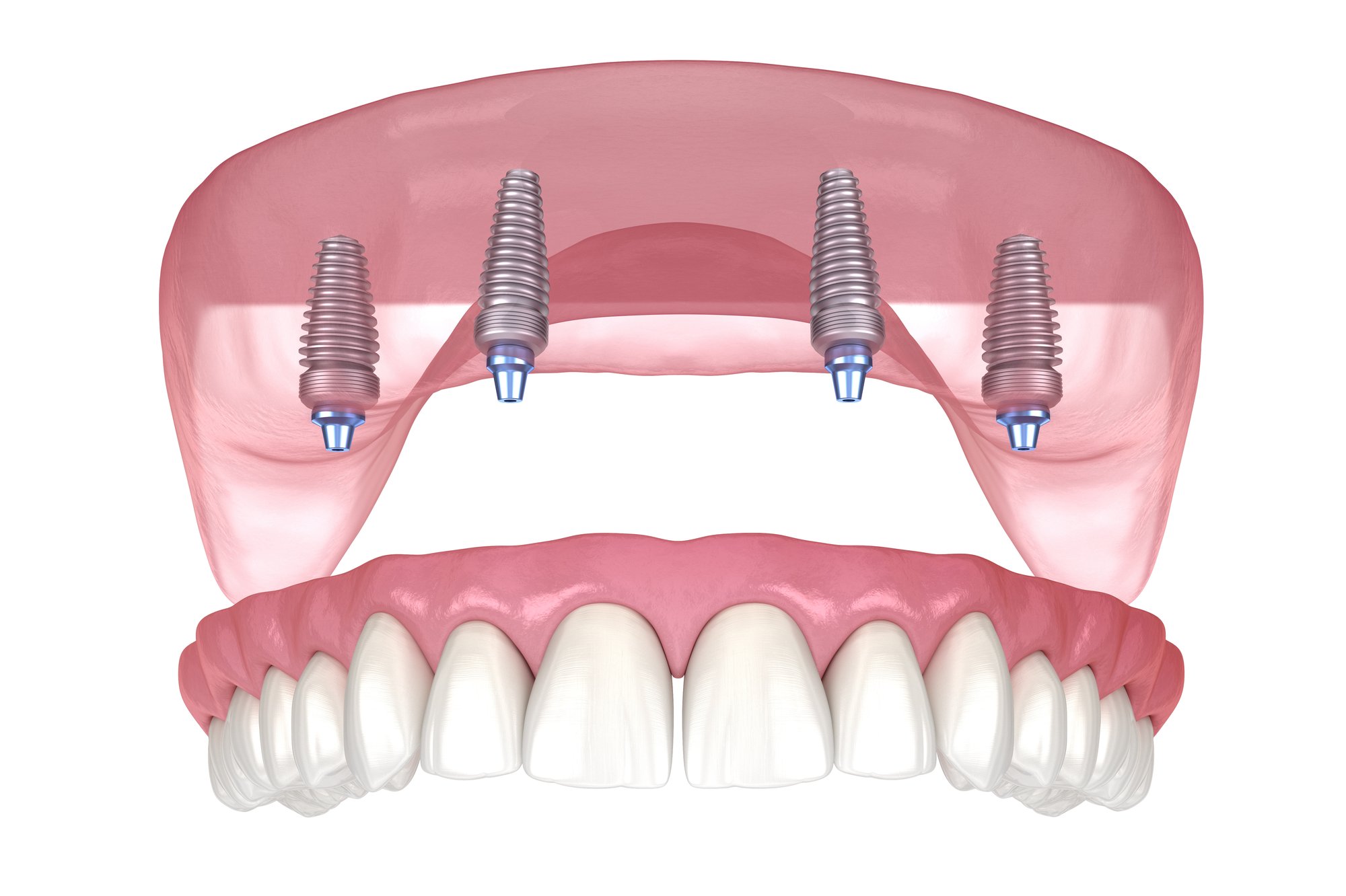
Been wearing dentures for years and wondering if implants are still an option? In most cases, you can still get All-on-4, even after long-term denture wear has taken a toll on the jawbone. All-on-4 is a full-arch restoration that anchors a fixed set of teeth to four strategically placed implants. All-on-4 implants replace an entire arch with a stable, non-removable set of teeth.
Key Takeaways
- The All-on-4 system relies on just four implants to carry a full arch of fixed, non-removable teeth.
- Long-term denture wear often causes bone loss, but most patients still qualify for treatment.
- The angled placement of the back implants uses denser bone and frequently avoids the need for grafting.
- A 3D scan of the jaw is what ultimately determines if you are a candidate for the procedure.
- Implants stimulate the jawbone and help slow the ongoing loss of bone.
What Are All-on-4 Implants?
This treatment is a full-arch solution designed for people who are missing most or all of their teeth in an upper or lower jaw, or whose remaining teeth are failing beyond repair. According to Cleveland Clinic, the procedure places four implants at the front and back of the jaw to support a full arch, with a temporary bridge fixed in place while the bone heals and fuses around the posts. Once healing is complete, usually after a few months of integration, a permanent and custom-made set of teeth is secured firmly to the implants. All-on-4 implants provide that fixed foundation, so the teeth stay put rather than resting loosely on the gums.
The appeal, especially for longtime denture wearers, is stability. A fixed arch stays firmly in place while you eat and speak, and it never calls for the adhesives that removable dentures depend on. Because only four implants support the entire arch, the treatment is also considerably more efficient, and often more affordable, than placing a separate implant for every missing tooth. For many, that stability means finally biting into an apple again on a hike through Paramount Ranch.
Do Years of Denture Wear Cause Bone Loss?
Yes, and this is the concern most long-term wearers raise. When natural tooth roots are gone, the jawbone no longer receives the stimulation it needs and gradually resorbs, or shrinks, over time. Removable dentures rest on top of the gum structure without replacing the root, so they do not halt this process and can even accelerate it. Years of continuous wear, therefore, often leave a patient with noticeably less bone than they began with, which is precisely why so many long-term wearers assume implants are off the table.
The encouraging part is that bone loss does not automatically disqualify you. The All-on-4 design places the two rear implants at a deliberate angle, allowing them to anchor into the denser, more resilient bone that usually remains toward the back of the jaw. This clever positioning frequently makes grafting unnecessary, even for patients who were told years ago, before the technique became widely available, that implants were simply not possible for them.
How Do You Know if You Can Get All-on-4?
Candidacy is determined by the amount and quality of bone you have, and that requires a proper evaluation. A 3D cone-beam scan gives a detailed, three-dimensional picture of the jaw, showing exactly where solid bone remains. From that image, a dentist can plan the implant placement precisely and determine if any preliminary steps, such as grafting, are needed before treatment begins. Most long-term denture wearers, it turns out, still have a viable path to fixed teeth, even when they arrive at the consultation convinced that their years in dentures have ruled the option out entirely.
In the rare cases where bone loss is severe enough to complicate treatment, additional options still exist, ranging from bone grafting to alternative implant configurations designed for difficult anatomy. Your dental team can walk you through what the scan reveals and which approach fits your anatomy best. The only way to know for certain is to look, which is exactly what the evaluation is for.
A Fixed Smile After Years of Dentures
If you have spent years managing removable dentures, you may be a better candidate than you think to get All-on-4 and return to fixed, stable teeth. All-on-4 implants use angled placement to work with the bone you still have, often without the need for grafting. Beyond the comfort and renewed confidence, the implants actively stimulate the jaw with every bite, which helps slow the further bone loss that removable dentures alone can never prevent.
- If you want to learn more about your candidacy for All-on-4, visit our All-on-4 Implants in Agoura Hills, CA, page or schedule a consultation.