

Table of Contents
The cheaper option upfront is not always the more economical choice over the years.
Trying to decide which tooth replacement is the smarter long-term investment? When patients weigh a dental implant or bridge, the deciding factor is often lifetime value rather than the initial price. A dental bridge is a fixed prosthetic appliance that closes a gap by using crowns on the nearby teeth to support a replacement tooth in the space between them. A dental bridge provides a dependable, surgery-free route back to a complete and functional smile. Both options can bring back a full, natural smile.
Key Takeaways
- The choice between an implant and a bridge usually turns on long-term value rather than the upfront cost alone.
- A dental bridge is typically faster and less expensive to place, and it does not require surgery.
- Bridges rely on the neighboring teeth for support, which usually must be reshaped to hold the restoration.
- Implants replace the tooth root itself, tend to last longer, and help preserve the jawbone beneath the gap.
- The right answer depends on your budget, your timeline, and the health of the teeth around the gap.
How Do a Dental Implant and a Bridge Differ?
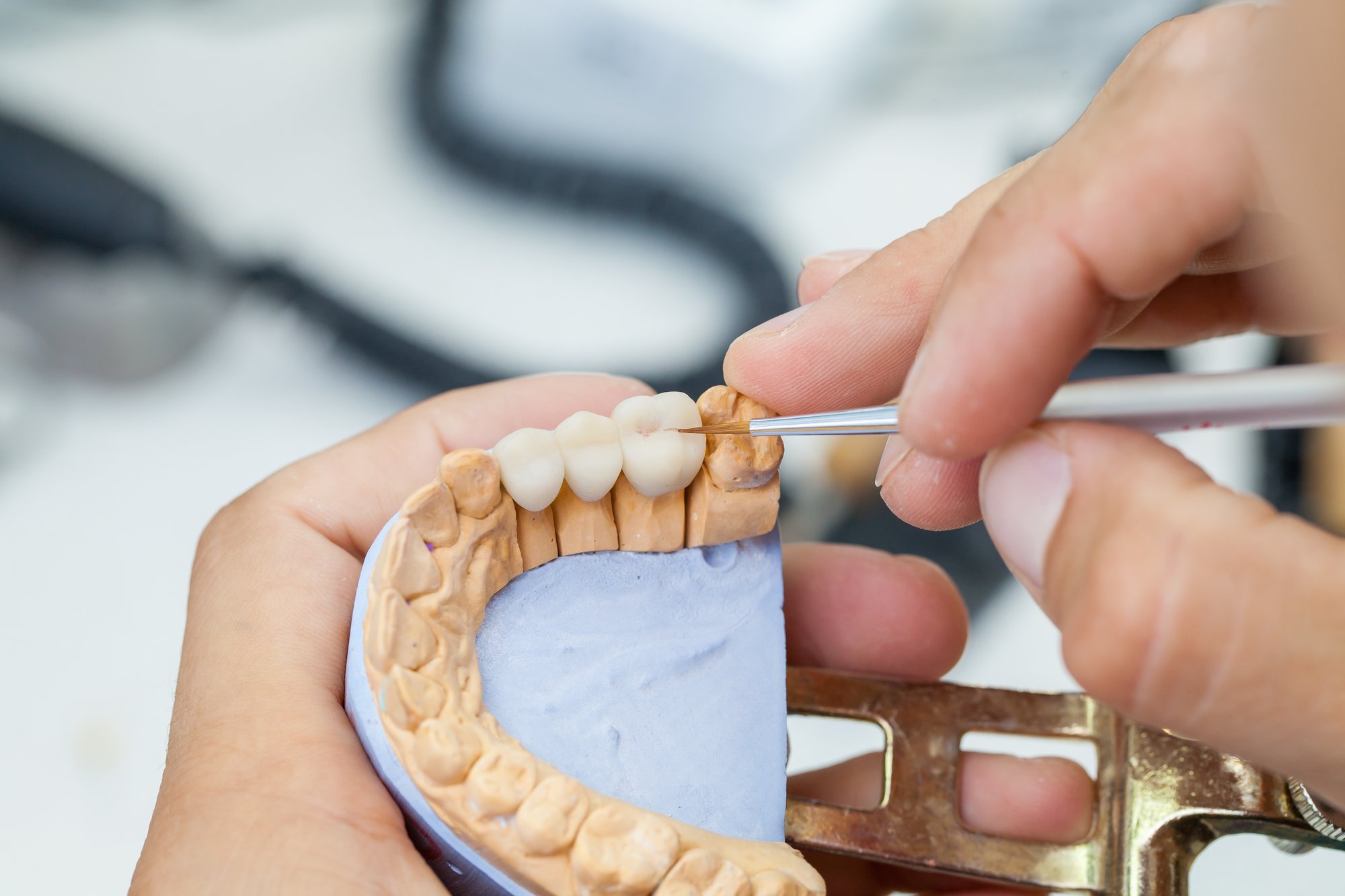
The two restorations solve the same problem in fundamentally different ways. According to Healthline, a bridge consists of false teeth held in place by the natural teeth around the gap, while an implant is an artificial tooth root, usually titanium, that is placed into the jawbone. A bridge sits above the gum line and leans on its neighbors for support, whereas an implant stands on its own beneath the gum. A dental bridge is a strong choice when the adjacent teeth are healthy, and you would rather avoid surgery, and either path can have you back to smiling on the job or at a show at The Canyon.
That structural difference drives nearly every other comparison between them. Because a bridge depends on the teeth beside the gap, those teeth are reshaped to accept the supporting crowns. An implant leaves the neighboring teeth entirely untouched, an advantage that many patients find appealing, though it does require a small surgical procedure and a healing period of several months before the final crown is placed.
Which Option Lasts Longer?
Longevity is where the two paths tend to diverge most clearly. A well-maintained bridge commonly holds up for roughly a decade and a half before replacement becomes necessary, largely because the supporting teeth can eventually weaken or develop decay beneath the crowns that anchor it. An implant is designed to last much longer, and the titanium post itself can endure for decades with good care. Because a bridge may be replaced once or twice over a lifetime, the running total can approach or exceed the one-time cost of an implant.
There is also the important matter of the bone that lies beneath the gap. An implant replaces the root and keeps stimulating the jawbone, which helps maintain its density and the shape of your face. A traditional bridge does not provide that stimulation, so the bone under the missing tooth can gradually thin over the years, a change that is invisible at first but can eventually alter both the fit of the restoration and the contour of the face.
Which One Actually Saves You More?
The practical answer is that it depends on your particular situation. If the teeth beside the gap are already crowned or in need of work, a bridge can be the sensible and economical choice. If those teeth are healthy and you are planning for the long term, an implant often wins on lifetime value despite its higher upfront cost, since it rarely needs replacing and protects the bone that a bridge simply cannot. Your budget, your timeline, and the overall health of your mouth all factor into the decision, and no single answer fits every patient.
This is a decision worth making together rather than from a price list alone. Your dental team can evaluate the teeth around the gap, take the necessary images, and lay out the true long-term cost of each path. With that information in hand, weighed against how long you expect to need the restoration, the choice that saves you the most over time usually becomes clear.
The Long View on Your Smile
Choosing between a dental implant or bridge is less about the first invoice and more about value measured over many years. A dental bridge delivers a fast, reliable, surgery-free way to restore a missing tooth, particularly when the neighboring teeth would benefit from crowns anyway. For other patients, particularly those with healthy neighboring teeth, an implant’s longevity and its ability to preserve the underlying bone make it the stronger long-term investment.
- If you want to learn more about choosing a dental implant or bridge, visit our Dental Bridges in Agoura Hills, CA, page or schedule a consultation.